

The Empire Always Returns
The original mythology of crypto is colliding with the political realities of money, debt, and state power.

In 2008, traders stood outside Lehman Brothers watching employees carry cardboard boxes out of the building while global markets unraveled in real time. The collapse happened faster than most people thought possible. One week earlier, the system still looked stable from the outside. Money moved normally. Credit markets functioned. Television analysts talked about temporary stress.
Then confidence vanished.
What followed was not simply a banking crisis. It was a psychological rupture. Governments printed trillions to stop the financial system from imploding, central banks flooded markets with liquidity, and an entire generation watched the foundations of modern finance reveal how fragile they really were.
Bitcoin emerged directly from that atmosphere of distrust.
The original promise of crypto was emotional before it was technological. People were not buying digital tokens because they cared about settlement efficiency or programmable finance. They were buying an alternative to institutions they no longer trusted.
Fifteen years later, something strange has happened.
The same financial system crypto was supposed to escape is slowly absorbing it.
Not because the imbalance disappeared, but because the system evolved faster than the public understood. Oil replaced gold as the mechanism holding global demand together. The petrodollar arrangement transformed energy markets into a global recycling system for U.S. debt. Countries needed dollars to buy oil. Oil exporters recycled those dollars into Treasuries. The machine continued.
Fifty years later, crypto appears to be drifting into a strangely similar role.
The System Learns Faster Than the Crowd
Most people still look at the Clarity Act as another chapter in the endless regulatory fight surrounding digital assets. They see debates over stablecoins, compliance standards, audits, licensing frameworks, and consumer protections. Markets react the way markets always do. Traders focus on price. Influencers focus on narratives. Politicians focus on optics.
But legislation like this rarely matters because of the language everyone reads first. Its significance comes from the incentives it quietly reorganises underneath the system.
The Rebellion Starts Wearing a Suit
The crypto industry spent years pretending institutional adoption would preserve the rebellious spirit that built the sector in the first place. That illusion is fading quickly.
The environment emerging now favors entities capable of integrating with governments, banks, Treasury markets, payment systems, and regulatory frameworks. Capital is no longer rewarding pure decentralization narratives with the same enthusiasm it once did. The market is slowly separating infrastructure from speculation.
That distinction matters for XRP.
For years, Ripple occupied an awkward position inside crypto culture. Bitcoin maximalists distrusted it because of its corporate structure. Retail traders mocked it during periods where price action stalled. Regulators targeted it aggressively through the SEC lawsuit. Yet while much of the industry focused on building parallel financial ecosystems designed to bypass institutions entirely, Ripple spent its time building relationships with the institutions themselves.
At first, that strategy looked outdated.
Now it looks early.
The Clarity Act changes the conversation because it accelerates a migration already happening beneath the surface of the industry. Regulation raises operational costs. Compliance requirements consolidate power upward. Smaller projects struggle under legal pressure, reserve requirements, reporting obligations, and licensing standards that large firms can absorb more easily.
Crypto is entering its banking era.
The comparison makes many people uncomfortable because the original mythology of digital assets revolved around escaping centralised financial control. Bitcoin emerged after the financial crisis carrying the emotional energy of distrust toward banks, governments, and monetary debasement. Early adopters believed decentralisation itself was the destination.
But institutions rarely tolerate uncontrolled monetary ecosystems indefinitely.
Eventually, states move in. Rules harden. Surveillance expands. Liquidity consolidates around approved structures.
The New Buyers of American Debt
Stablecoins are where this transformation becomes easiest to observe.
The current compromise surrounding the Clarity Act reportedly limits stablecoin issuers from offering traditional savings-style interest on passive deposits while still allowing rewards tied to activity, transactions, or network participation. On paper, the distinction sounds technical. In practice, it reveals where power wants the system to go.
Banks are protecting their territory.
Stablecoins backed by Treasuries can theoretically distribute yield more efficiently than traditional banks burdened by legacy overhead and regulatory capital structures. If stablecoins begin functioning too effectively as digital savings vehicles, deposits migrate away from banks and toward blockchain infrastructure.
Washington does not want uncontrolled migration.
What it does want is global demand for digital dollars.
That is the part many investors still underestimate.
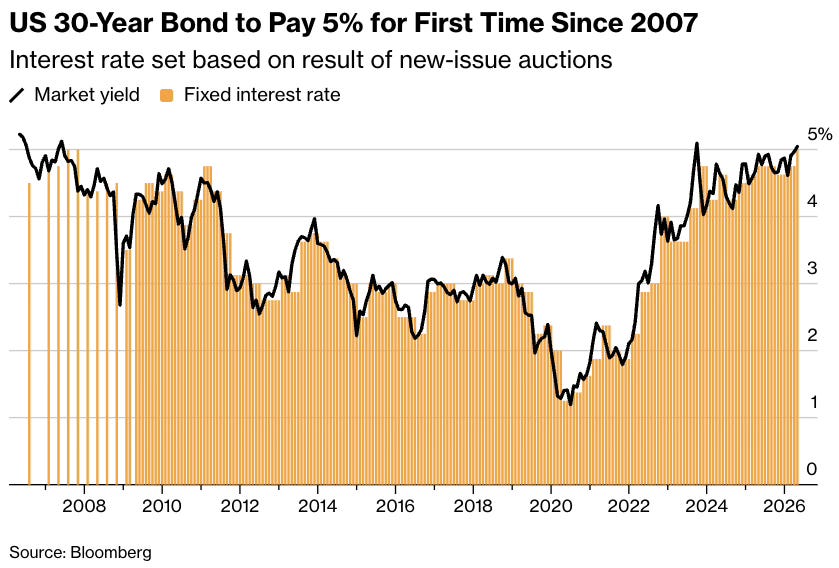
The United States is approaching a period where Treasury financing requirements are becoming increasingly difficult to ignore. Debt issuance continues climbing while foreign appetite for long-duration Treasuries has weakened compared to previous decades. Yields remain elevated because the system requires constant buyers.
Stablecoins create buyers.
Every dollar-backed stablecoin effectively channels liquidity into Treasury instruments sitting underneath reserve structures. The broader digital dollar ecosystem expands demand for U.S. debt indirectly while extending dollar usage globally through blockchain rails.
The mechanism starts resembling a digital version of the old petrodollar framework.
Only now the infrastructure moves through wallets instead of oil shipments.
This is why the conversation around central bank digital currencies feels strangely incomplete. Public resistance toward CBDCs remains high because people instinctively understand the implications of programmable money. They understand the danger of financial systems capable of monitoring, rewarding, restricting, or discouraging behavior at the transaction level.
Stablecoins provide a politically softer route into similar infrastructure.
They arrive wrapped in private-sector branding rather than direct state control. They feel innovative instead of authoritarian. Consumers engage with them voluntarily through convenience, yield opportunities, and faster settlement systems. Yet the underlying framework still becomes deeply integrated with Treasury markets, regulatory oversight, and monitored payment rails.
The distinction between public and private control becomes blurrier than many crypto idealists expected.
XRP Was Built for a Different Endgame
Ripple’s positioning inside this environment explains why XRP continues surviving despite years of skepticism.
The company is not trying to overthrow the financial system. It is trying to become part of its plumbing.
That difference changes everything.
The market still contains thousands of projects built around narratives that increasingly feel disconnected from where institutional capital is moving. Meme speculation will continue because speculation is permanent human behavior. But the long-term concentration of serious liquidity appears increasingly tied to assets capable of functioning within regulated financial architecture.
XRP’s supporters often frame the asset as a bridge between traditional finance and digital settlement infrastructure. Critics dismiss that language as corporate marketing. Yet when governments begin constructing legal frameworks specifically designed to integrate blockchain systems into regulated finance, the projects already aligned with that direction stop looking accidental.
They start looking strategically placed.
None of this guarantees some spectacular linear rise in XRP’s price. Markets rarely reward conviction cleanly. Regulation itself may still produce years of volatility, legal friction, liquidity squeezes, and political conflict. Many retail investors continue imagining crypto as another cycle of instant wealth creation where random tokens explode higher without consequence.
That period may already be fading.
The next phase looks colder. More institutional. More controlled. Less ideological.
When Systems Stop Resisting Power
Which brings the story back to the collapse of Lehman Brothers and the panic that followed.
Monetary systems survive by adapting their infrastructure before confidence fully breaks. Bretton Woods evolved into the petrodollar system because the United States understood that reserve currency status depends less on ideology than on creating mechanisms the world cannot easily avoid using.
Digital dollars, stablecoins, regulated blockchain rails, and assets like XRP may simply represent the next version of that adaptation. Not a financial revolution escaping empire.
A financial revolution absorbed by it.